Presentation video
Why this matters
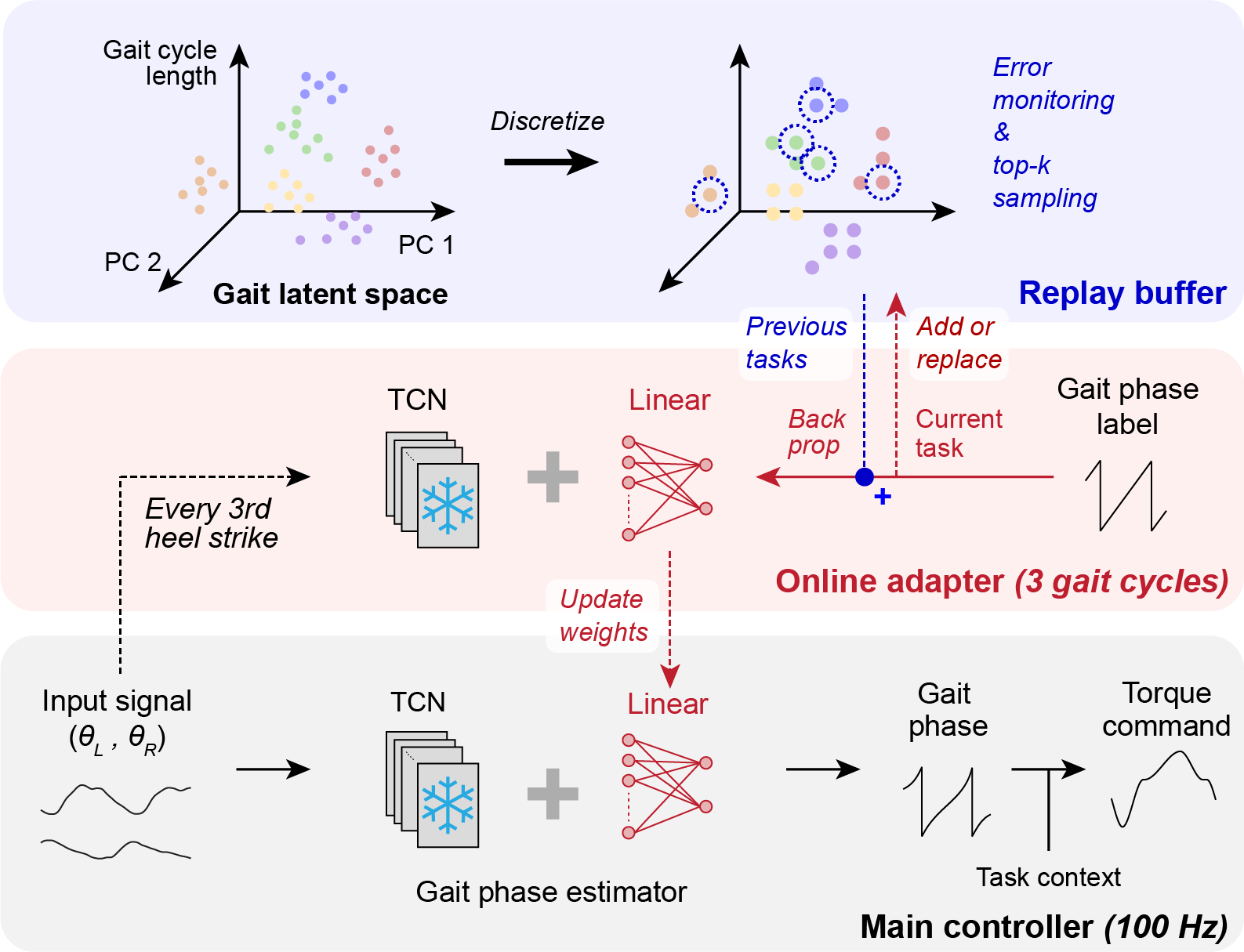
Continual online adaptation
Updates the gait phase estimator in real time with sparse sensors, so assistance timing remains personalized as the user and task change.
Task-aware replay without labels
Uses a gait manifold to group similar locomotor states, avoiding explicit task labels during replay selection.
Reduced catastrophic forgetting
Preserves previously learned assistance behavior across task transitions by replaying the most error-prone prior bins.
Users encountered a series of scenarios designed to replicate continual online personalization during daily ambulation.
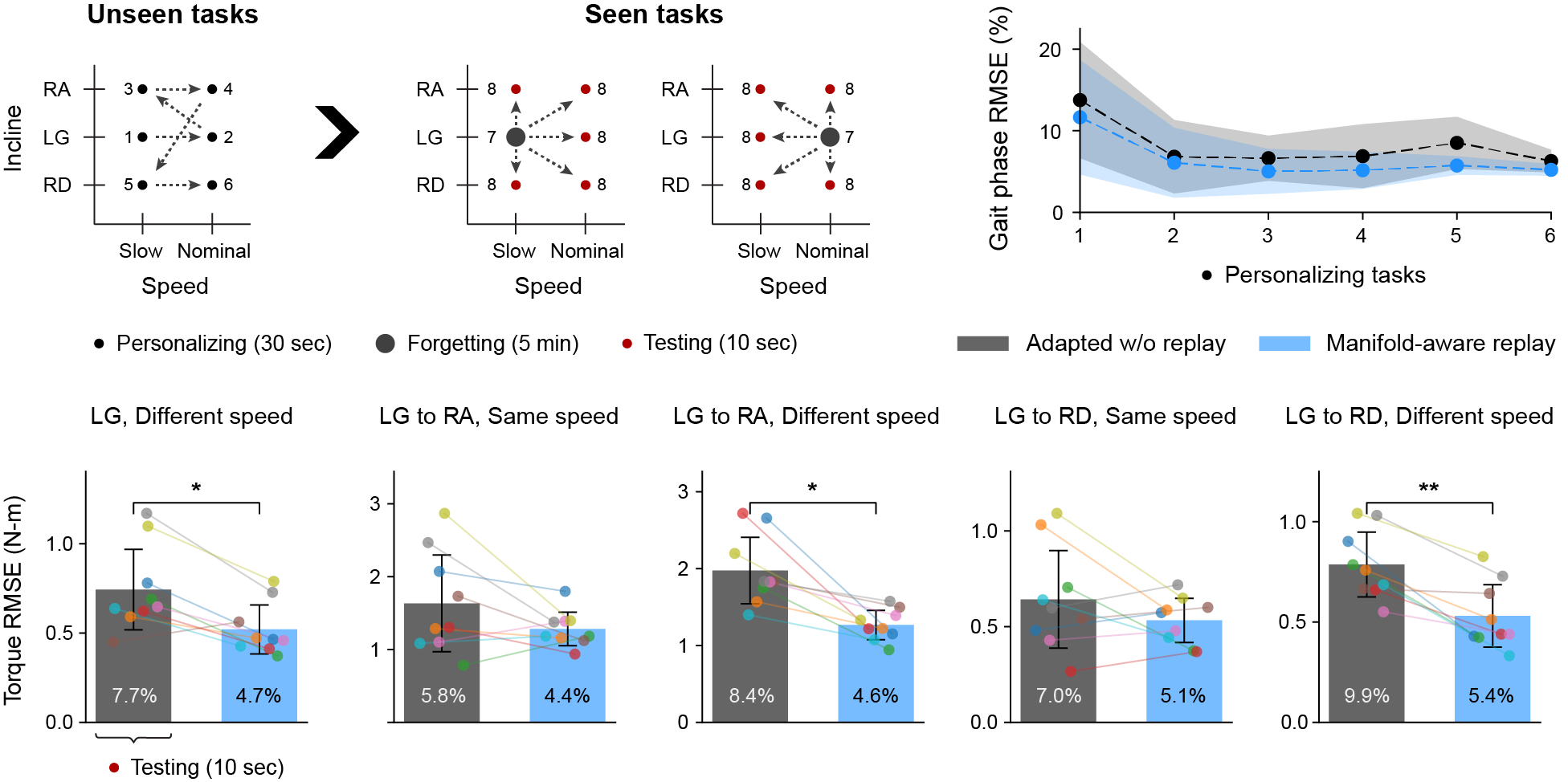
Scenario 1: Personalization across multimodal tasks
The user transitions across multiple locomotor modes while the controller updates online. The replay mechanism saves ongoing task's data and labels within the gait manifold.
Scenario 2: Forgetting in long-exposured task
The user is exposured to a single task for 5 minutes. The replaying framework keeps repalying previously seen data, while the baseline continuously update with current task.
Scenario 3: Testing on forgotten tasks
The controller is tested on other tasks than the one for forgetting. The replaying framework preserves its experiences on other tasks, while the baseline suffers from forgetting.
Framework at a glance
Method
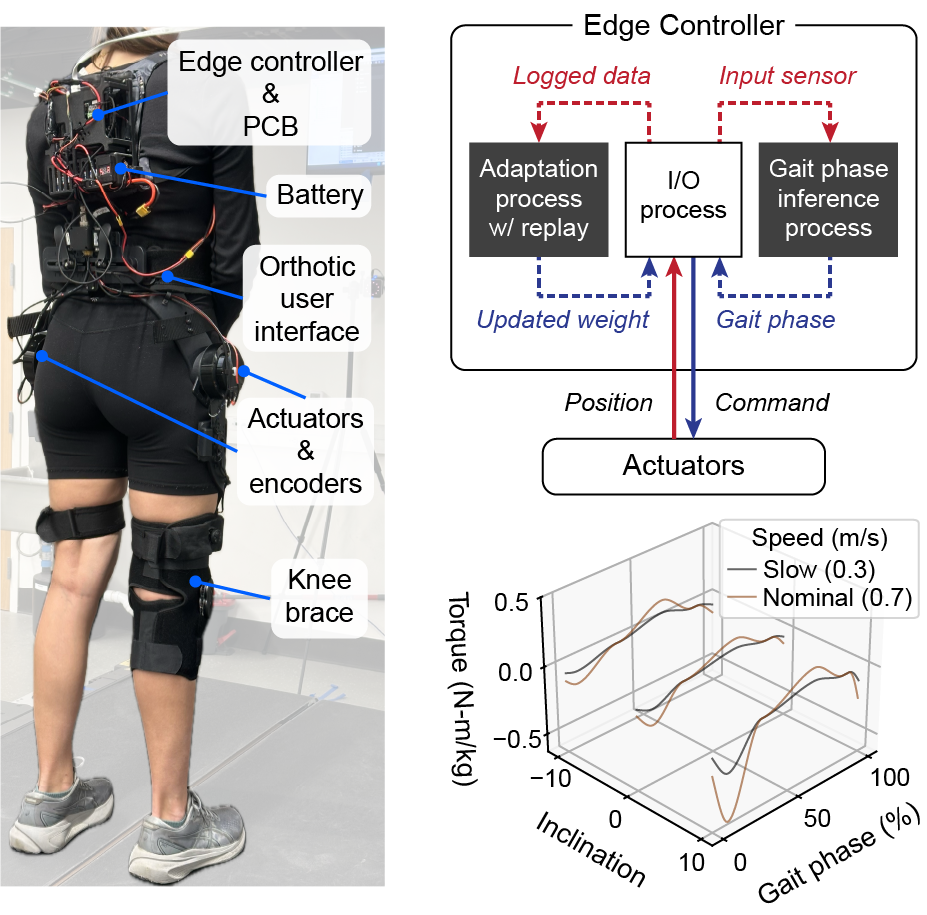
Exoskeleton HW & SW
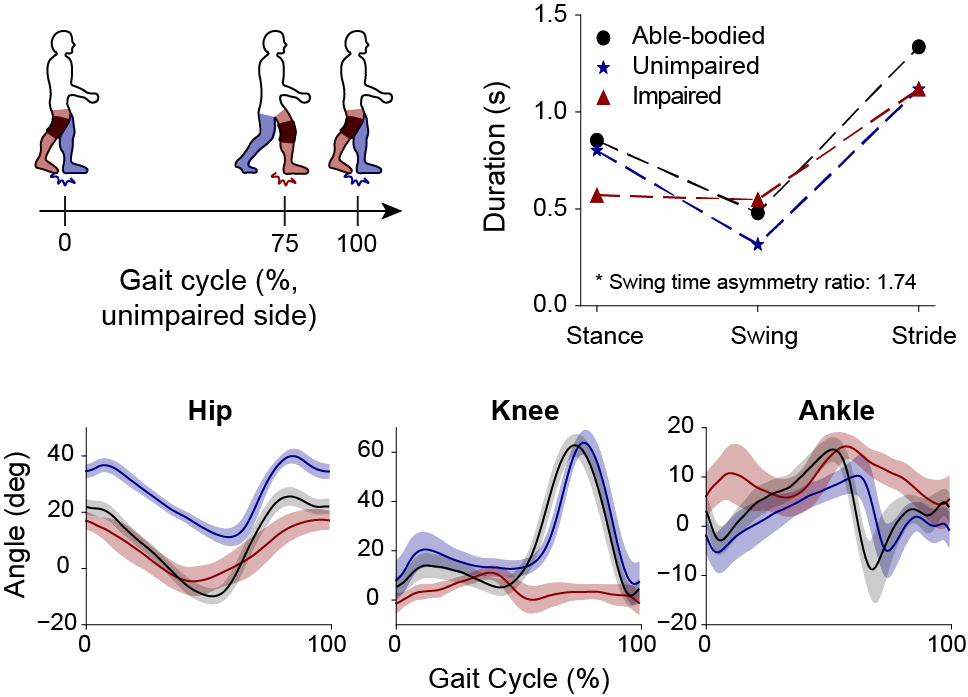
Hemiplegic gait emulation
Main results
Citation
BibTeX
@article{song2026continual,
  title={Continual Online Personalization of Exoskeleton Control via Manifold-Aware Experience Replay},
  author={Song, Changseob and Kang, Inseung},
  journal={arXiv preprint arXiv:2606.17455},
  year={2026},
  url={https://arxiv.org/abs/2606.17455}
}